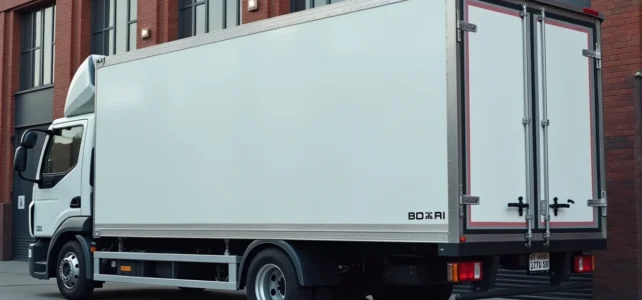
The 3.5-ton threshold alone structures a large part of road transport regulations in France. It determines the necessary license, the applicable technical control regime, the registration obligations for transporters, and, recently, access to low-emission zones. Understanding the vehicles that revolve around this limit requires distinguishing what is actually covered by the GVW, the payload, and the different body types available on the market.
GVW and payload: what the 3.5-ton threshold changes concretely
The gross vehicle weight (GVW) corresponds to the maximum mass that the vehicle can reach once loaded, including the driver. The payload is calculated by subtracting the unladen weight from the GVW. For a utility vehicle rated at 3.5 tons GVW, the actual payload generally ranges from one ton to one and a half tons, depending on the standard equipment and the chosen body type.
This distinction is not trivial. A vehicle whose GVW does not exceed 3.5 tons can still be driven with a category B license. Beyond that, a C1 license (up to 7.5 tons) or a C license becomes mandatory, which also changes the costs of training and insurance. The characteristics of 3.5-ton vehicles therefore determine in advance the required driver profile and operational constraints.
The technical control also adheres to this boundary. In France, utility vehicles under 3.5 tons follow the same schedule as passenger vehicles. Beyond that, the regime shifts to that of heavy utility vehicles, with more demanding frequencies and inspection points. In Belgium, the Brussels-Capital Region explicitly classifies N2 category vehicles (over 3.5 tons) under a distinct inspection regime.
Van, tipper, chassis-cab: what type of 3.5-ton vehicle for what use
The market for utility vehicles close to 3.5 tons is first segmented by body type. Each configuration meets a specific logistical need, and the choice impacts both the available payload and the vehicle’s versatility.
- The large volume panel van remains the most common configuration. The Renault Master, Fiat Ducato, or Mercedes-Benz Sprinter offer 3.5-ton GVW versions with loading volumes that can exceed ten cubic meters. They serve both urban delivery and craftsmanship.
- The rear tipper or three-way tipper is aimed at construction and landscaping professions. The hydraulic tipping mechanism facilitates the unloading of bulk materials, but the tipper itself weighs more than a simple flatbed, which reduces the net payload.
- The chassis-cab offers the greatest freedom of bodywork. It serves as a base for mounting a drop-side platform, a refrigerated box, or a workshop cell. The Iveco Daily and MAN TGE are frequently chosen in this configuration for GVWs ranging from 3.5 to 5.5 tons.
- The motorhome or converted truck occupies a distinct segment. Many models are based on a 3.5-ton utility base, but the interior layout absorbs a significant portion of the payload, limiting the weight of luggage and equipment that can be carried.
Low-emission zones and electrification: the pressure on 3.5-ton diesel utilities
Several major French metropolitan areas are gradually restricting access for older diesel utilities. Low-emission mobility zones (ZFE-m) apply criteria based on the Crit’Air sticker, and utilities classified as Crit’Air 3 or higher are already excluded from certain city centers. This constraint directly impacts the fleets of 3.5-ton vehicles used for last-mile delivery.
The electrification of the segment is progressing, but not uniformly according to usage. Electric vans, such as the Renault Master E-Tech or the Mercedes eSprinter, primarily target urban distribution, where daily distances remain compatible with the range of current batteries. In contrast, tipper or refrigerated configurations pose additional challenges: the weight of the batteries further reduces the payload, and the energy needs of the refrigeration unit add to the traction consumption.
Field feedback varies on this point. Some urban fleet operators report lower maintenance costs and easier access to ZFE. Others, particularly in construction or intercity refrigerated transport, believe that the electric offering does not yet meet their load and distance constraints.
Transport capacity and administrative obligations in France
Operating a utility vehicle for professional purposes in France requires holding a professional capacity certificate. For vehicles not exceeding 3.5 tons GVW, this is the so-called “light” certificate. Beyond that, the “heavy” certificate is required, accompanied by the designation of a transport manager holding the corresponding level.
The access conditions to the profession are fundamentally the same for both sectors: stable establishment, professional honorability, financial capacity, and professional capacity. However, the amounts required for financial capacity differ significantly between light and heavy. Registration in the national electronic register of transport companies remains mandatory in both cases.
For international operations, the regulatory boundary becomes more complex. A transporter holding only the light capacity cannot operate a community license for cross-border trips with vehicles between 2.5 and 3.5 tons without switching to the obligations of heavy transport, including the designation of a heavy-level manager.
Trailer and combined GVW: when 3.5 tons is no longer enough
Towing a trailer with a 3.5-ton utility vehicle changes the regulatory framework. The combined GVW (tractor vehicle plus trailer) determines the required license. As long as the total does not exceed 4,250 kg, a category B license is sufficient, provided that a supplementary training course (B96) has been completed. Beyond that, a BE license becomes necessary.
This option allows for increased loading capacity without changing vehicle categories, but it also requires checking the compatibility of the towing device, the vehicle’s towing capacity, and compliance with axle weight limits. The gain in volume or payload is real, as long as the stability of the whole is not neglected, especially on open roads.
The choice between a utility vehicle with a higher GVW (5 tons, 7.5 tons) and a 3.5-ton vehicle with a trailer depends on the usage profile. For regular trips with heavy loads, upgrading avoids the constraint of daily towing. For occasional needs, the trailer remains the most flexible and least expensive solution to acquire.