
Graphic design training relies on precise evaluation grids: typographic hierarchy, chromatic consistency, multi-platform readability. These criteria produce operational professionals, but they also generate a smoothing effect on the visual choices of students. Measuring this effect means understanding where the tension between academic framework and graphic uniqueness really lies.
Evaluation Grids and Visual Uniqueness: What Curricula Really Assess
To understand how a graphic design program addresses creativity, one must look at what its deliverables measure. Three types of criteria coexist in most programs, from BTS to specialized school diplomas.
| Type of Criterion | What is Evaluated | Impact on Personal Creativity |
|---|---|---|
| Technical | Mastery of software, adherence to format constraints, quality of execution | Neutral: a transversal skill that neither restricts nor stimulates a visual choice |
| Normative | Adherence to composition rules, typographic grids, accessibility | Framing effect: students converge towards similar visual solutions |
| Uniqueness / Approach | Coherence of the message, originality of the angle, ability to justify choices | Favorable: encourages formulating a personal intention, but often a minority in the final grade |
The imbalance lies in the weighting. Normative and technical criteria account for the majority of the grade in regular exercises. Uniqueness weighs more in the final project than in continuous assessment, creating a temporal gap: the student spends several semesters internalizing norms before being asked to deviate from them.
This gap explains a phenomenon documented by several teachers in art schools: entire cohorts produce visually homogeneous deliverables for two years, then struggle to differentiate themselves at graduation.
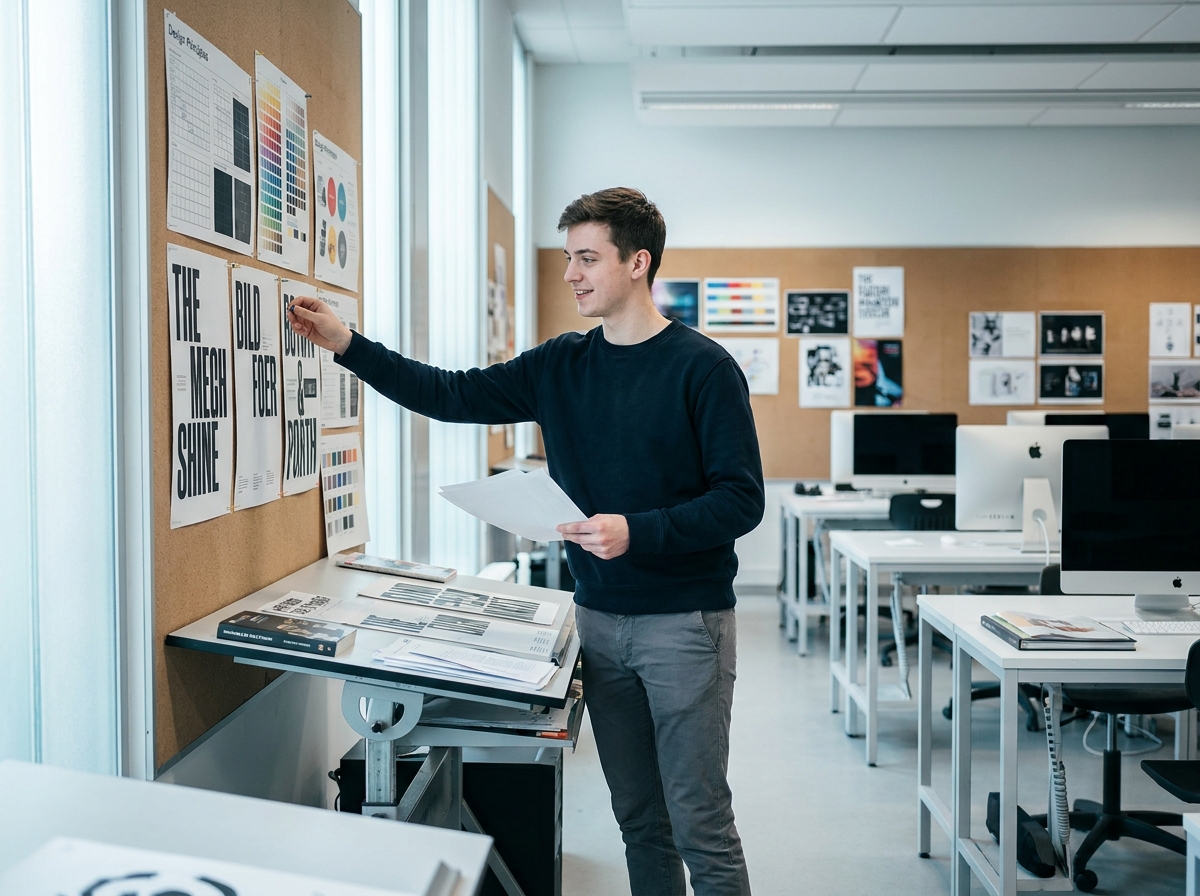
The possibility of studying graphic design while remaining creative therefore depends less on the program itself than on the emphasis placed on uniqueness criteria from the first semesters.
Design Diploma Projects: Personal Anchoring as an Emerging Criterion
Design graphic diploma juries increasingly value final projects rooted in personal commitments (ecology, minorities, territories) rather than solely exercises modeled on agency briefs. This shift modifies what schools concretely expect from students.
A diploma project centered on a personal subject necessitates graphic choices that do not respond to a client brief. The typographic register, palette, and format are dictated by the author’s intention, not by an external specification. The jury then evaluates the coherence between the message and the form, reversing the logic of previous exercises.
Several higher art schools have formalized this focus in their jury reports between 2023 and 2025. The concrete effect: students who maintained a personal graphic practice alongside their curriculum arrive better prepared for this exercise.
Parallel Practices that Feed a Unique Visual Language
Three channels emerge as experimentation grounds outside the school framework:
- Micro-mission platforms (Malt, Fiverr, Comeup) serve as real-world laboratories: the student tests visual directions on real assignments, with immediate client feedback that differs from academic feedback
- The sketchbook or digital visual journal (Notion, Are.na) allows for accumulating references and trials without deliverable constraints, creating a reservoir of graphic intentions that can be exploited later
- Self-initiated projects published on Behance or Instagram function as a living portfolio, distinct from the school portfolio, where visual risk-taking is not penalized by a grade
These parallel practices build a graphic vocabulary that the curriculum alone does not produce. The difference between a student who graduates with a recognizable voice and another who masters the tools without a signature often lies in the existence of these non-academic spaces.
Generative AI in Design School: Clarifying Uniqueness by Contrast
Some schools now use generative AI tools as pedagogical counter-examples. The principle: ask the student to produce an image via Midjourney or DALL-E, then compare it with their own production on the same brief.
The exercise forces a precise question: what in your work could not be generated by an algorithm? AI serves here as a mirror that reveals what pertains to uniqueness and what pertains to learned reflexes.
Teachers who practice this exercise report an unexpected effect: students more easily identify their visual tics (unconscious repetitive choices) than their true preferences (deliberate decisions that shape their style). The distinction between tic and preference then becomes a tool for progression.
Artistic Identity Modules in Recent Curricula
In response to the fear of formatting profiles, several programs have integrated modules dedicated to personal artistic identity since 2023. These modules do not focus on technique but on the ability to name and defend a visual intention.
The format varies: writing workshops on one’s approach, peer critique sessions, exercises reformulating a brief by injecting a personal angle. The goal is not to create a “style” but to make graphic preferences conscious that guide the student’s choices.

Agency Internships and Free Exploration Slots
Large agencies and studios are beginning to integrate free exploration slots into their internships to attract creative profiles graduating from school. The principle recalls the famous personal projects on Fridays, but applied to the internship framework.
For the intern, this slot offers a space where exploratory work is not subject to client validation. For the agency, it allows assessing creative potential beyond the execution of standard briefs.
The tension between academic framework and personal creativity is not resolved by a binary choice. Students who navigate their training with an intact graphic voice are those who have multiplied spaces for free practice, used school constraints as a technical foundation without making them their only horizon, and learned to name what makes their work recognizable. The curriculum provides the grammar, but the visual vocabulary is built elsewhere.