
A socket equipped with a ground pin does not guarantee that the protective conductor is actually functioning. Testing the ground of a house without a multimeter requires distinguishing between two realities that many sources confuse: the physical presence of a green/yellow wire in the socket and the actual effectiveness of the ground circuit down to the earth. Accessible methods without measuring devices can identify the most common faults, but each has its limitations.
Presence of ground and effectiveness of ground: two concepts that simple tests measure differently
A green/yellow conductor connected to the pin of a socket proves that a wire exists. It says nothing about the continuity of this wire to the ground bar, nor about the quality of the contact between the stake (or loop) and the ground. A present ground can be ineffective if the wire is cut in the sheath, if a terminal is loose in the panel, or if the stake is in soil that is too dry.
Before applying a testing method, this distinction determines what can actually be concluded without measuring instruments.
| Method without multimeter | What it checks | What it does not check |
|---|---|---|
| Socket tester with lights | Presence of ground on the socket, phase/neutral inversion | Actual resistance of the ground, continuity to the stake |
| Visual inspection at the panel | Connection of the green/yellow wire to the bar, apparent condition of the connections | Quality of the stake-ground contact, ohmic value |
| Inspection of the ground bar | Existence and accessibility of the cut-off point | Underground condition of the stake, buried corrosion |
| Bulb test (deliberate short circuit) | Tripping of the differential | Actual reliability of the fault loop, resistance value |
The table shows that each approach covers one link in the chain, never the whole. To obtain a reliable picture of the installation, several checks must be combined.
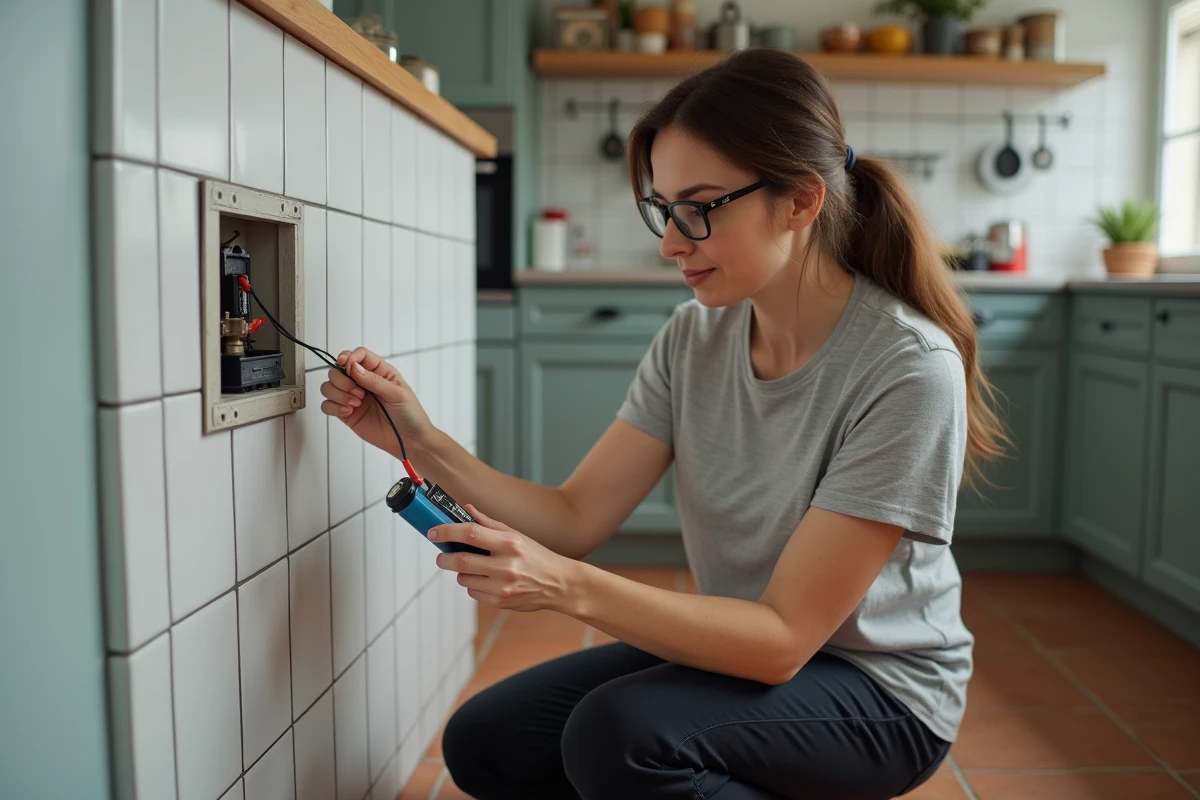
Socket tester with lights: the only truly reliable tool without electrical skills
The socket tester plugs directly into the wall socket. Three indicator lights show the detected configuration: ground present, ground absent, phase and neutral reversed. The method for testing the ground of a house without a multimeter that remains the most accessible is this device, available for a few euros at a hardware store.
The light tester detects the absence of ground but not a degraded ground. If the green/yellow wire reaches the socket, the light will turn on, even if the ground resistance is too high to ensure real protection. A green light does not exempt from a complementary check at the panel.
Concrete limitations of the light tester
- It does not measure ground resistance: a value that is too high prevents the differential from tripping quickly enough, but the tester still shows “ground OK”
- It does not detect a green/yellow wire mistakenly connected to the neutral (wiring fault encountered in some partial renovations)
- It only works on sockets with a pin, not on lighting circuits or dedicated lines (plates, water heaters)
Visual inspection of the electrical panel and ground bar
Opening the cover of the electrical panel allows for spotting several clues without any measuring tools. The green/yellow wire must go from each circuit to a ground bar (distribution terminal) that is clearly identifiable. If this terminal is absent, if green/yellow wires are cut or not connected, the installation has a visible fault.
The ground cut-off bar, often located at the bottom of the panel or near the meter, connects the entire protection network to the main conductor that goes down to the stake. Checking its existence and accessibility takes less than a minute.
What the panel reveals in an old house
In houses built before the widespread adoption of current standards, it may happen that the ground simply does not exist. The absence of a green/yellow wire in the conduits, a panel without a distribution bar, or two-hole sockets without a pin are all signals. A panel without a visible protective conductor indicates an installation not connected to the ground.
Partial renovations pose another problem: some rooms have been brought up to standard (kitchen, bathroom) while the rest of the circuit retains old wiring. The socket tester may then show “ground OK” in the kitchen and “ground absent” in a bedroom, making checking each socket essential.
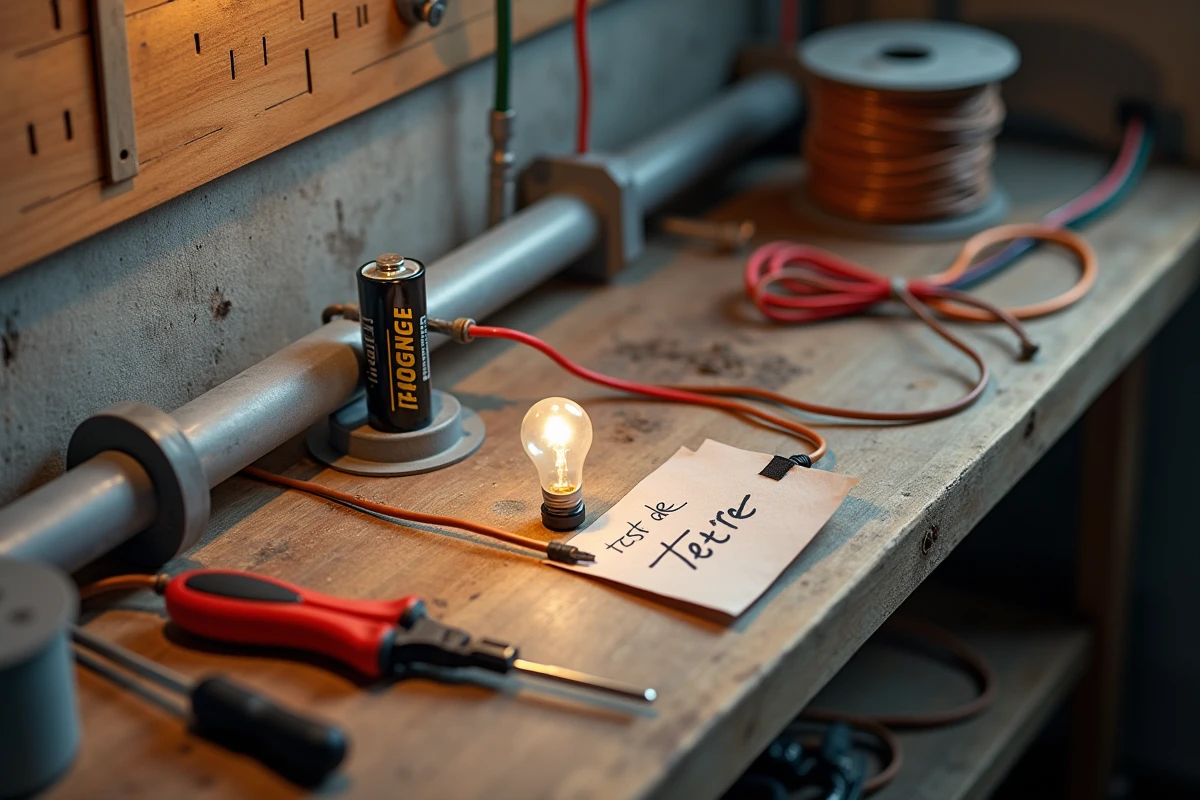
Bulb test and deliberate short circuit: a risky and unreliable method
This technique involves connecting a wire between the phase of a socket and the ground pin via a bulb, to create a leakage current and check if the differential breaker trips. This test is not recommended for individuals without electrical training.
The tripping of the differential proves that a fault current is flowing to the ground, but it does not provide information about the resistance value of this ground. A differential set to 30 mA can trip even with a poor ground, giving a false sense of security.
On the other hand, if the differential does not trip, it confirms either the absence of ground or a continuity fault between the socket and the stake. The negative result is more informative than the positive result, which greatly limits the usefulness of the method.
When to call an electrician to measure ground resistance
Visual methods and the light tester cover the detection of the most obvious faults: absence of conductor, wire not connected, socket without pin. They do not replace a ground resistance measurement performed with a tellurometer, the only device capable of quantifying the quality of the stake-ground contact.
- If the light tester indicates “ground OK” on all sockets but you feel tingling when touching a metal device, the ground resistance is probably too high
- If the house dates from before the 1990s and has never undergone an electrical diagnosis, a professional measurement can validate or invalidate what the visual inspection suggests
- If you are preparing a sale or rental, the mandatory electrical diagnosis includes ground measurement and provides a usable numerical value
Checks without a multimeter identify obvious faults but do not measure ground resistance. A socket tester combined with a panel inspection covers most common situations. For old houses, partially renovated, or in case of doubt after these initial checks, measurement by an electrician remains the only way to confirm that the ground actually protects the installation.