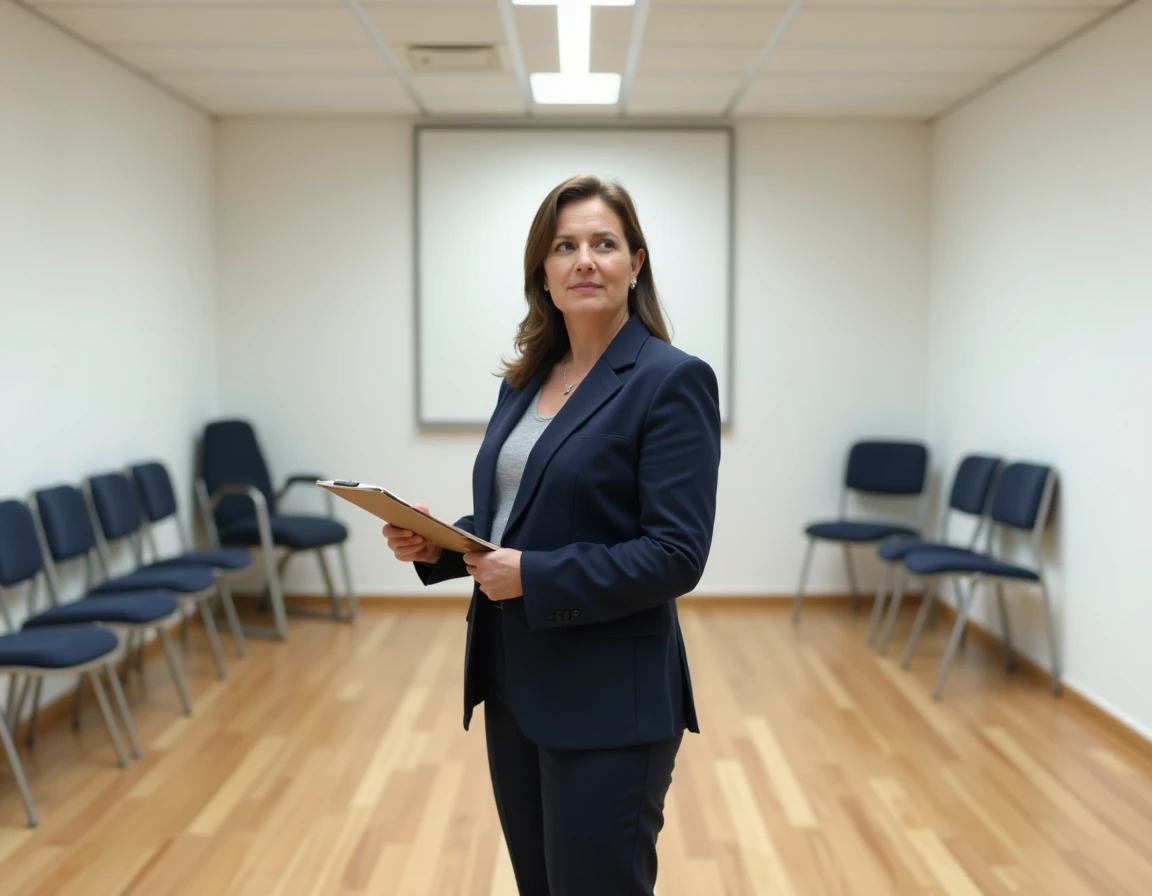
A 30 m² room does not have a fixed capacity. The commonly suggested ratio of 1.5 m² per person in a seated configuration yields about twenty seats, but this figure only holds on paper. In practice, the actual capacity depends on the arrangement of furniture, the nature of the event, and regulatory constraints related to clearances and fire safety.
Clearances and accessibility: what reduces the usable capacity in 30 m²

Before counting chairs, we recommend subtracting the non-compressible area. The ERP (establishment receiving the public) regulations do not only consider the surface area per person ratio. They impose minimum widths for clearances and exits proportional to the admitted number of people, which significantly reduces the usable area beyond what an online calculator displays.
In a 30 m² room, the turning space for a person in a wheelchair alone takes up a significant portion of the area. Accessibility standards require sufficient passage widths and a clear maneuvering space in front of each exit. In a compact format, this can reduce the actual capacity by several seats compared to the gross calculation.
Emergency exits add a constraint that is often overlooked: their swing (door opening outward) prohibits placing furniture in a clearance arc. To know precisely how many people to accommodate in a 30 m² room, one must first outline these dead zones on a plan before placing any seats.
Net area by configuration: meeting, training, and reception in 30 m²

The chosen configuration can double or halve the capacity. A theater setup (chairs aligned without tables) compresses the needs per person, while a classroom format with tables significantly increases them. Here are the benchmarks we use for a standard rectangular room of 30 m², once clearances are deducted.
- Theater configuration (chairs only, rows facing a screen): the usable area allows for 20 to 25 people, provided that walkways are kept accessible.
- Classroom configuration (tables and chairs oriented towards a speaker): count about 2 m² per participant, which brings the capacity down to 12-15 seats depending on the depth of the tables.
- U-shape or hollow square configuration (peripheral table, empty center): this format consumes a lot of linear space. In 30 m², it becomes difficult to exceed 12 to 14 people seated comfortably.
- Standing cocktail reception: the ratio drops to around 1 m² per person, but the duration of the event matters. Beyond two hours, the density becomes uncomfortable and pushes guests towards the exit.
These ranges assume an empty space to start with. Any fixed footprint (bar, buffet, stage, audiovisual equipment) directly subtracts from the available area.
Furniture and equipment: the invisible square meters
A floor-standing projector, a flip chart, or a two-meter-long buffet each occupy floor space that is systematically forgotten in the initial calculation. We regularly observe organizers who plan their capacity based on the gross area, only to discover on the day that two or three seats are missing.
Each additional piece of equipment removes at least one seat. A tripod screen with its projection distance easily consumes 3 m² of floor space. A catering area with tablecloth and chafing dishes takes up just as much. Listing these items before setting the capacity avoids last-minute adjustments.
Duration of occupancy and actual comfort: the factor that calculators ignore
A surface-to-person ratio says nothing about the comfort felt over time. The acceptable density decreases as the duration of occupancy increases. For a 30-minute briefing, squeezing 25 people into 30 m² remains tolerable. For a full-day training session with the same number of people, the room becomes a furnace.
Ventilation plays a direct role. A limited air volume, combined with a high number of people, raises the temperature and CO2 levels much faster than in a larger space. In a 30 m² room with a standard ceiling height (about 2.50 m), the total air volume remains modest. Beyond about fifteen people in prolonged occupancy, the lack of mechanical ventilation quickly degrades working conditions.
Expected level of interaction
A frontal conference tolerates a higher density than a participatory workshop. As soon as participants need to move, form subgroups, or access materials, the space required per person increases. For a collaborative workshop in 30 m², we do not exceed 10 to 12 people, even if the theoretical calculation would allow for more.
Summary table: recommended capacity for a 30 m² room
| Configuration | People (range) | Note |
|---|---|---|
| Theater | 20-25 | Short event, no table |
| Classroom | 12-15 | Individual or double tables |
| U / hollow square | 12-14 | Interactive meeting |
| Standing cocktail | 25-30 | Duration less than 2 hours |
| Workshop / seminar | 10-12 | Frequent movements |
These figures include regulatory clearances and a minimum level of comfort. They assume a rectangular room without pillars or fixed stages.
The best approach remains to draw a scaled plan with the actual furniture, clearance areas, and planned equipment. A spreadsheet calculation provides an estimate, while a scaled plan gives a definitive answer.