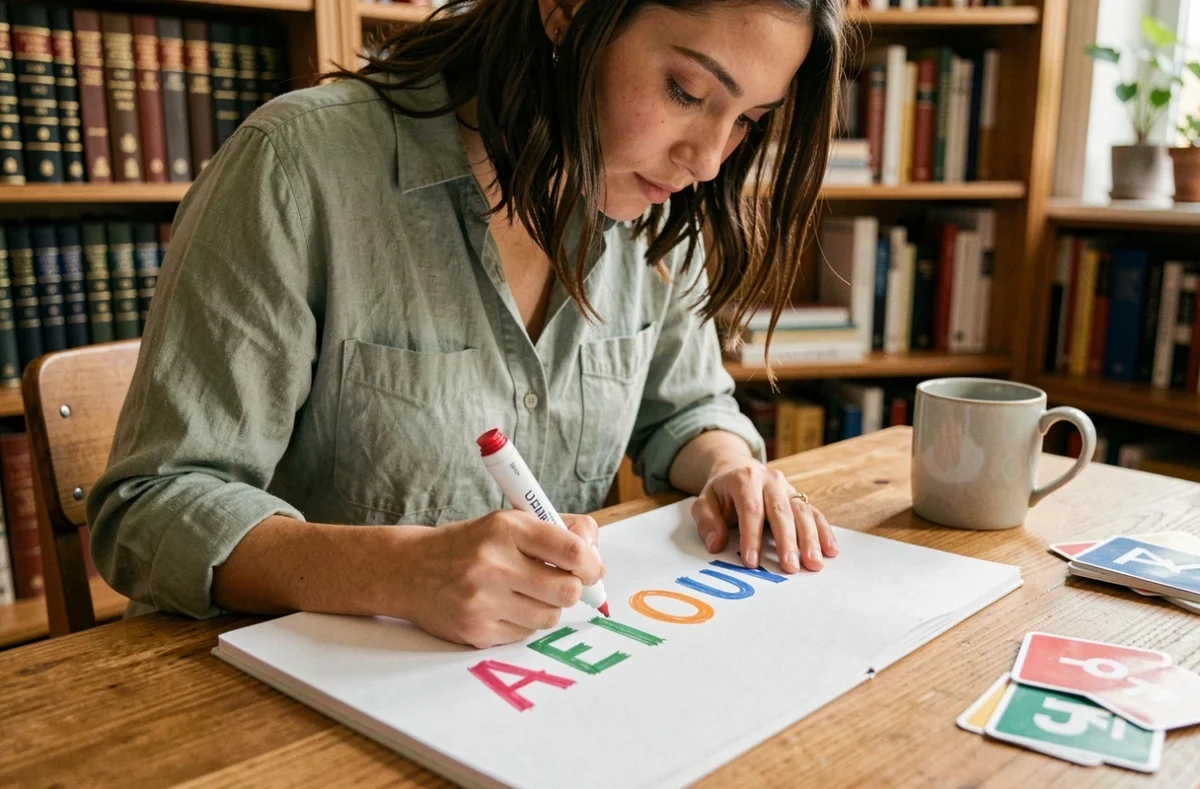
A child in kindergarten who confuses E and I in syllable dictation, or who systematically forgets Y in the list of vowels: we have all encountered this situation. The problem rarely stems from a lack of repetition, but rather from the way these six letters are presented.
Often presented as a sequence to recite, they lack a concrete function. Memorizing the vowels A E I O U Y becomes easier when each letter is anchored in a sound, a gesture, or a manipulable word.
Why the mouth and throat help retain each vowel
Before pulling out an alphabet poster, one can start with a purely physical exercise. Ask the child to pronounce each vowel slowly and feel what moves: the position of the lips, the opening of the mouth, the vibration in the throat. The A opens the mouth wide. The O rounds the lips. The I stretches them. The U tightens them forward.
This bodily approach gives each vowel a sensory identity, not just a visual one. We do not remember six abstract signs; we remember six distinct positions of the mouth. Associating an articulatory gesture with each letter helps long-term memory, especially in children who remember better through movement than through sight.
E and Y often pose more difficulty. E because it produces several sounds depending on the words (the “e” in “me” is not the same as in “été”). Y because it is sometimes classified with consonants in children’s minds.
A useful reference: pronounce “lyyyy” while stretching the sound, then “liiiii,” so the child hears the relationship. A guide to learning the vowels that details this sound-based approach helps structure the progression.

Memorizing vowels with decodable words rather than a nursery rhyme
Nursery rhymes and songs about vowels are everywhere. They work to retain the order of the list, but they do not guarantee that the child can recognize a vowel in a real word. One can recite “A E I O U Y” without being able to spot the I in “lit.”
The current recommendation in reading pedagogy is to quickly move on to simple consonant-vowel combinations: ma, mi, mo, lu, sa, si. The child then gives a concrete function to each vowel. Instead of six letters suspended in the void, they manipulate syllables that they can read and write.
A sorting exercise that works well in practice
Prepare images of common objects (cat, bed, bowl, wall, die, pen). The child must say the word, isolate the vowel they hear the loudest, and then place the image under the correct letter. This sound sorting anchors each vowel in a concrete word, making memorization more stable than simple recitation.
- Cat, bag, lake for A: the mouth opens wide, the sound is easy to isolate even for the youngest.
- Bed, magpie, friend for I: the lips stretch, the sound is high-pitched and distinctive.
- Bowl, motorcycle, bike for O: the lips round, the child can exaggerate the shape to better remember.
- Moon, wall, turtle for U: the lips project forward, which physically distinguishes it from O.
- Pen, pajamas, swan for Y: it shows that Y produces the same sound as I in these words.
E is intentionally treated separately because its sound variants (mute e, é, è) require more time. Feedback varies on this point depending on the child’s age, but starting with the “é” of “été” works as a first reference.
Writing and encoding vowels: the gesture that fixes memory
Recognizing a vowel by ear and recognizing it on a sheet are two different skills. Having the child write the heard vowel consolidates the link between sound and letter. One pronounces a word, and the child writes just the vowel they identify. There’s no need to write the entire word.
For example, one says “friend.” The child writes “a” then “i.” One says “motorcycle.” They write “o” twice. This encoding exercise, recommended in recent phonics approaches, transforms the child into an active producer rather than a passive receiver of the alphabet.

Mobile letters and slate: two practical supports
Magnetic or wooden letters allow for composing syllables without the constraint of writing. A child who struggles to write U by hand can still select it from the letters placed in front of them and place it after an M to form “mu.”
The wipeable slate has another advantage: it desacralizes the error. Write an A instead of an O, erase, start again. Repetition without stakes reduces anxiety and increases the number of attempts in a single session.
Progression of vowel memorization: when to move on
Start with the vowels whose sounds do not vary: A, I, O, U. Once the child identifies them in simple words and knows how to write them, add Y by showing its closeness to I. E comes last, with its variants.
- Step 1: recognition of the isolated sound (the child says “aaa” while opening their mouth, shows the corresponding letter).
- Step 2: spotting in a short word (hearing A in “bag,” I in “magpie”).
- Step 3: consonant-vowel combination (reading and writing “ma,” “li,” “bo”).
- Step 4: spontaneous encoding (one says a word, the child writes the vowels they hear).
This step-by-step progression avoids overloading working memory. Each mastered vowel becomes a decoding tool, not just a simple list item.
The criterion for moving from one step to the next is concrete: the child identifies the vowel without hesitation in three different words, at two distinct times of the day. If the identification remains fragile the next morning, one resumes with new words rather than repeating the same ones.
Varying the words prevents the child from memorizing a fixed association (A = cat and nothing else) and builds a recognition that is truly transferable.