
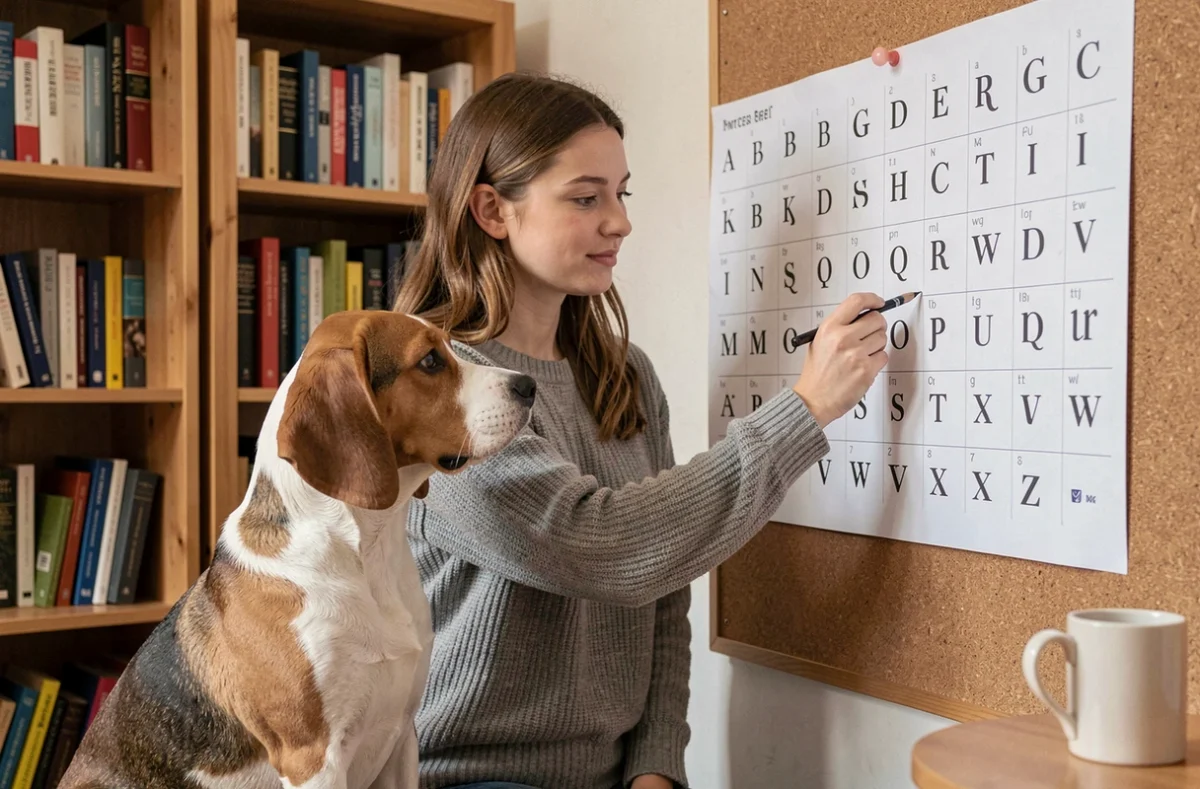
The word “character” has two meanings in French. One refers to temperament, and the other refers to a written symbol. When asking the question “what character do dogs not know how to use?”, the answer lies precisely at the intersection of these two meanings. Dogs communicate through body language, voice, and gaze, but writing completely eludes them.
Canine language and written signs: why the trick question works
The phrasing plays on the ambiguity of the term “character.” In typography, a character is a letter, a number, or a punctuation mark. The dog does not manipulate any of these symbols. It does not trace letters, form words, or read sentences.
This inability is not a cognitive limitation in a pejorative sense. Dogs have not developed a writing system because they have never needed one. Their communication relies on sensory channels that are far more effective for their species: postures, tail movements, vocalizations, pheromones.
If you want to learn more about the missing character in dogs, the answer revolves around the at sign, the hashtag, or any other typographic symbol, depending on the variant of the riddle. The humorous twist remains the same: the dog ignores the alphabet.

Canine cognition and understanding of human words
While dogs cannot write, they can decode part of our spoken language. Research from the Dog Cognition Centre at the University of Portsmouth shows that dogs interpret human pointing gestures better than wolves and chimpanzees. They pick up on the intention behind a pointed finger, a focused gaze, or a head movement.
Learning words also exists, but it concerns an exceptional minority of individuals. A study published in Biology Letters in 2024 (Dror, Miklósi, and Fugazza) reports that some dogs, primarily Border Collies, manage to retain the association between a word and an object over time. This ability remains rare and does not generalize to all dogs.
In other words, your companion may recognize “ball,” “walk,” or “sit” without ever being able to spell those words. Understanding comes through sound and context, not through written signs.
Dog temperament: what breed does not predict
The other meaning of the word “character” deserves attention because misconceptions persist. Many families choose a breed thinking they will get a guaranteed temperament. The available data do not validate this approach in such a mechanical way.
The Société Centrale Canine relays the conclusions of an American study involving a large sample of dogs: breed does not reliably predict individual behavior. The factors influencing an animal’s character are multiple:
- The daily environment and the quality of interactions with humans, which shape the dog’s emotional responses from its earliest months
- Early socialization, meaning exposure to other animals, varied noises, and new situations before the age of four months
- The education received and the consistency of signals sent by the owner, a point that canine behaviorists regularly emphasize
- The physical and mental health status, which directly influences the animal’s reactivity and tolerance threshold
A mixed breed adopted from a shelter can turn out to be calmer than a breed known for being placid, and vice versa. Canine behaviorist Cyril Courrioux summarizes the situation with the phrase “like dog, like owner”: the dog absorbs the emotions and habits of its surroundings.
Anthropomorphism and interspecies communication
Projecting human capabilities onto an animal is a common reflex. We attribute guilt, resentment, and pride to dogs. Anthropomorphism distorts the reading of canine signals and can exacerbate behavioral problems.
When a dog averts its gaze after knocking over a trash can, it is not expressing shame. It reacts to the tension it perceives in its owner. Canine language relies on micro-body signals (ear position, jaw tension, breathing rhythm) that we often interpret through a human filter.
This confusion partly explains why the riddle about “the character that dogs do not use” makes people smile. It highlights a fundamental disconnect: we think in letters and words, while they think in smells, postures, and sounds. The dog communicates without any written support, and it does so with an efficiency that millennia of co-evolution with humans have refined.
Dog trainer or behaviorist: who to consult
If your dog’s character raises questions (in terms of temperament this time), two professionals can intervene. The dog trainer works on obedience and basic learning. The behaviorist analyzes the underlying causes of a problem (aggression, separation anxiety, phobia).
These two professions are not interchangeable. A certified ACACED trainer can teach recall or leash walking. A behaviorist, often trained in ethology, seeks to understand why the animal reacts in a certain way before proposing an appropriate protocol.
The choice depends on the situation. A puppy that pulls on a leash falls under training. An adult dog that consistently growls in the presence of children requires a thorough behavioral assessment, sometimes coupled with a veterinary evaluation.
The riddle about the character that dogs cannot use is a typographic joke. The real question, which occupies owners, veterinarians, and researchers, is how an animal without written language manages to communicate with remarkable precision.